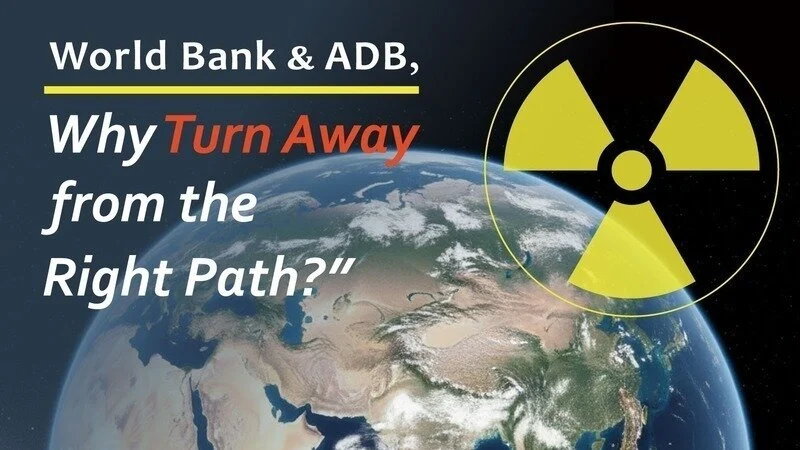
Say No to Nuclear Financing – World Bank and ADB, Why Turn Away from the Right Path?
Why this petition matters:
- The World Bank and the Asian Development Bank (ADB) are international financial institutions funded by governments to support economic development, poverty reduction, and infrastructure.
- Until now, both institutions have avoided supporting nuclear power projects for the following reasons:
- nuclear proliferation risks
- serious concerns over safety
- radioactive waste
- extremely high costs
- On June 10, the World Bank’s Board decided to lift its ban on financing nuclear projects.
- The ADB is currently reviewing its energy policy, and indications suggest it may also move to allow support for nuclear power.
- However, the problems of nuclear power — safety risks, radioactive waste, nuclear proliferation, and high costs — remain unresolved.
- Introducing nuclear power in developing countries would impose major risks and costs not only on today’s citizens but also on future generations.
For these reasons, we are preparing to send the following petition to both the World Bank and ADB. We ask for your support by adding your signature. We will submit all signatures and comments to the World Bank and ADB.
👉Let’s act together to prevent today’s decisions from burdening tomorrow’s generations.
——
International Petition: “Say No to Nuclear Financing – World Bank and ADB, Why Turn Away from the Right Path?”
To: Mr. Ajay Banga, President of the World Bank Group
To: Mr. Masato Kanda, President of the Asian Development Bank
We are deeply concerned that the World Bank Group and the Asian Development Bank (ADB) are moving toward lifting the ban on financing and supporting nuclear power projects.
The core reasons why the World Bank and the ADB have long refrained from supporting nuclear energy include inseparable risks of nuclear weapons proliferation and the unresolved problems of radioactive waste. These concerns remain unchanged today. Furthermore, Russia’s invasion of Ukraine has revealed that nuclear power plants can become military targets, adding another serious security threat.
As demonstrated by the Chernobyl and Fukushima Daiichi nuclear disasters, one accident can cause widespread, long-term contamination and serious social and economic disruption.
Even without accidents or attacks, nuclear energy releases radioactive substances into the environment at every stage of its lifecycle—mining, fuel production and processing, operation, decommissioning, and the disposal of spent nuclear fuel. Uranium mining, in particular, has often violated the rights of Indigenous peoples and harmed their health, lands and environment.
Nuclear waste generated from operating nuclear power plants remains hazardous for tens of thousands of years, requiring secure isolation from the biosphere for geological periods of time. Yet most countries still have no disposal site.
Due to “security” considerations, some information related to the planning and construction of nuclear power plants is kept secret. As a result, communities and NGOs often have limited access to crucial safety information. This lack of transparency conflicts with the safeguard policies of international financial institutions which emphasize openness, accountability, and stakeholder consultation.
In recent years, the cost of building nuclear power plants has soared, often reaching tens of billions of USD per unit and increasing several-fold beyond initial estimates. Private investors have shifted away from nuclear power and toward renewable energy, leading to the rapid growth of renewable energy technologies. The high costs of nuclear power – now the most expensive form of new electricity generation – and its requirement for large direct and indirect government subsidies have high opportunity costs, delaying and undermining the needed rapid scale-up of benign renewable energy.
Construction of nuclear power reactors typically takes well over a decade, often more than two, too slow for mitigating the accelerating climate crisis.
We must also recognize the vulnerabilities of nuclear power. As a large, centralized source of electricity, nuclear plants can have far-reaching impacts when they unexpectedly shut down due to accidents or technical problems. In recent years, heatwaves have raised seawater and river temperatures, making it impossible to obtain cooling water in some cases.
Small modular reactors (SMRs) also fail to address many of these concerns, especially those related to fissile material, radioactive wastes, nuclear weapons proliferation risks and economic viability.
Supporting the construction of nuclear power plants in developing countries would impose not only serious long-term dangers but also a massive economic burden on current and future generations in those nations.
We therefore call on the World Bank Group and the ADB to refrain from providing any form of support or financing for nuclear power.
Initial Endorsers:
11 march movement, Belgium
350.org Japan, Japan
Aktionsbündnis STOP Westcastor Jülich, Germany
AKW-nee-Gruppe Aachen, Germany
Alliance for Climate & Ecology, Korea
Australian Conservation Foundation (ACF), Australia
AYUS International Buddhist Cooperation Network/アーユス仏教国際協力ネットワーク, Japan
Belgische Coalitie Stop Uraniumwapens (Belgian part of the International Coalition for a Ban on Uraniumweapons), Belgium
Beyond Nuclear, United States
Bündnis für „Sichere Verwahrung von Atom-Müll, Germany
Centre for Financial Accountability(CFA), India
Citizen’s Eyes on Nuclear Regulation/原子力規制を監視する市民の会, Japan
Citizens’ Commission on Nuclear Energy (CCNE) /原子力市民委員会, Japan
Citizens’ Nuclear Information Center/原子力資料情報室, Japan
Climate Express11 march movement, Belgium
Corner House, United Kingdom
Ecodefense, Russia
Environmental Association “Za Zemiata” – Friends of the Earth Bulgaria, Bulgaria
European Environmental Bureau, Belgium
Forum for Protection of Public Interest (Pro Public) , Nepal
Friends of the Earth Australia, Australia
Friends of the Earth India, India
Friends of the Earth International, International
Friends of the Earth Japan, FoE Japan/Japan
Friends of the Earth United States, USA
GAIA Asia Pacific, Regional
Green Action/グリーン・アクション, Japan
Green Citizens’ Action Alliance, Taiwan
Growthwatch , India
Grup de Científics i Tècnics per un Futur No Nuclear, Catalunya
Humanistische Union – Beratung für Frauen, Familien und Jugendliche e.V., Germany
Initiative 3 Rosen e.V., Germany
Institute for Sustainable Energy Policies (ISEP) /環境エネルギー政策研究所, Japan
International Physicians for the Prevention of Nuclear War (IPPNW), USA
Jamaa Resource Initiatives, Kenya
International Rivers, International
Japan Center for a Sustainable Environment and Society (JACSES) /「環境・持続社会」研究センター (JACSES), Japan
Jubilee Australia Research Centre, Australia
Just Finance International, International
Kiko Network, Japan
Legal Rights And Natural Resources Center, The Philippines
Manhattan Project for a Nuclear-Free World, United States
Mütter gegen Atomgefahr / Mothers against Nuclear Hazard, Austria
New Diplomacy Initiative/新外交イニシアチブ, Japan
NGO Forum on ADB, Regional
No Nuke Oslo, Norway
No Nukes Asia Forum Japan, Japan
NOAH Friends of the Earth Denmark, Denmark
Noé21, Switzerland
Nuclear-Free Bataan Movement, Philippines
Nuclear Information and Resource Service, USA
NVMP-Artsen voor vrede, The Netherlands
Oyu Tolgoi Watch, Mongolia
Pakistan Fisherfolk Forum, Pakistan
Peace Boat/ピースボート, Japan
Physicians for Social Responsibility, USA
RECH contre le nucléaire, France
Redaktion anti atom aktuell, Bundesrepublik Deutschland
REScoop.eu, Belgium
Réseau “Sortir du nucléaire”, France
Rivers without Boundaries Mongolia, International
San Francisco Bay Physician for Social Responsibility, USA
Stroom naar de Toekomst Limburg, Netherlands
The Liaison Committee for Organizations of Victims of the Nuclear Disaster/原発事故被害者団体連絡会(ひだんれん), Japan
Union of Concerned Scientists (UCS), USA
Urgewald, Germany
VAKS Verenigde Actie kern Stop (United Action Nuclear Stop), Belgium
WALHI, Indonesia
Women against nuclear power, Finland
Women for peace, Finland